Why Attention Is Becoming the Real Currency of OOH
Introduction
Date
Author
billups
Type
Articles
Out-of-Home (OOH) advertising has always been about visibility. For decades, reach, frequency, and impressions have served as the core metrics for evaluating campaign performance.
Those metrics still matter. But they no longer tell the whole story.
Urban environments are denser with visual information than ever before. Digital screens, retail signage, street infrastructure, and competing media all fight for the same fleeting moment of attention. In this landscape, the difference between an ad that registers and one that fades into the background can determine whether a campaign drives real impact.
That shift is pushing the OOH industry toward a deeper question: how effectively does a placement capture attention?

The Limits of Exposure-Based Measurement
Traditional OOH measurement models were built around the opportunity to see. If a media unit was visible to passing audiences, it counted as an impression.
Yet two placements with identical impression counts can perform very differently in practice.
A billboard positioned against a simple skyline may command attention, while another, surrounded by dense visual clutter, competes with traffic signs, storefronts, and neighboring ads. Creative design also plays a role; contrast, composition, and message hierarchy all influence whether a viewer registers the ad at a glance.
Understanding these differences requires looking beyond exposure and toward how human perception interacts with the environment around an ad.
This is where attention-based measurement begins to reshape how campaigns are evaluated.
A Framework for Measuring Attention
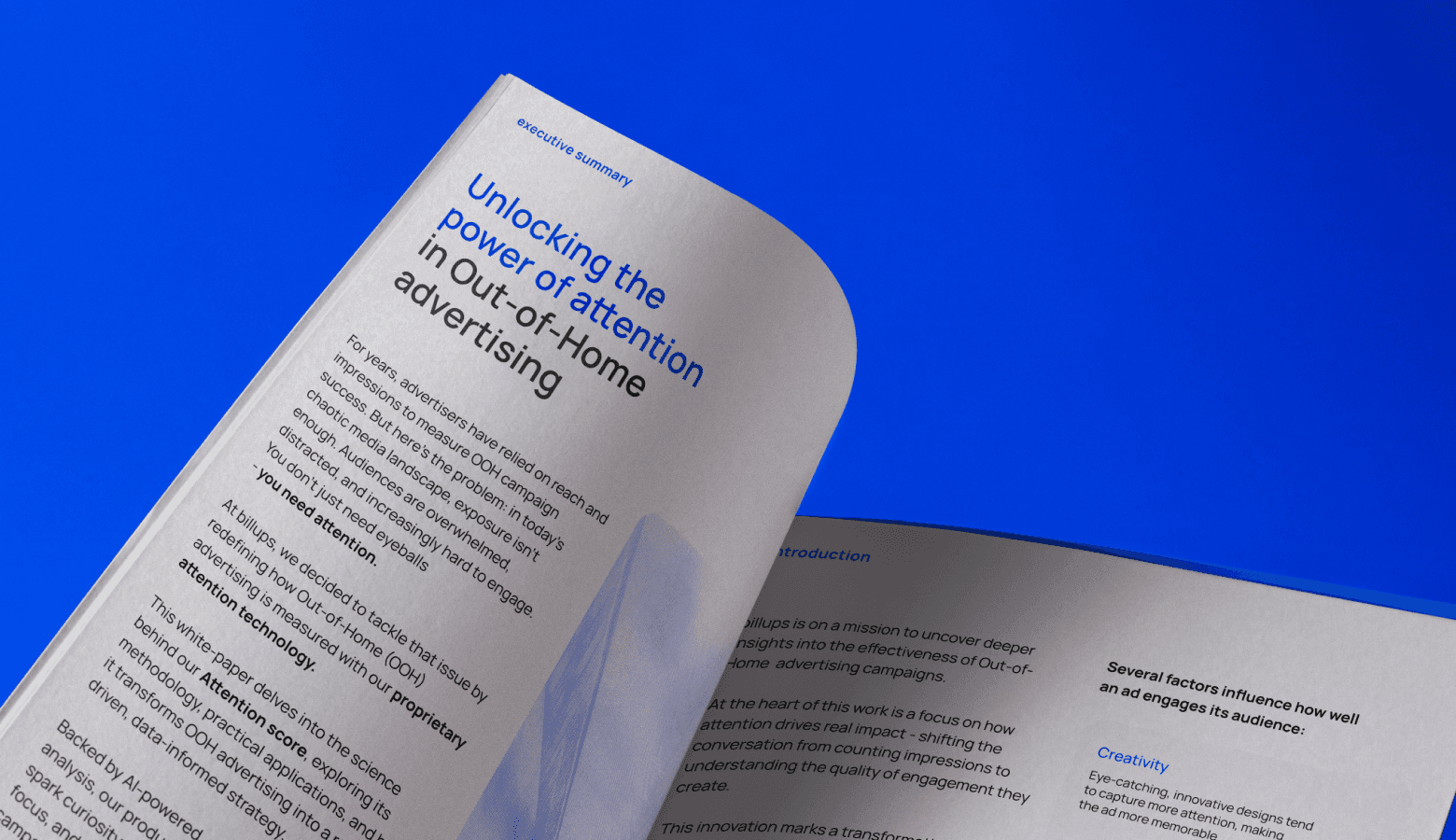
In our latest whitepaper, Attention Score Unlocked: A Data-Driven Guide to OOH Excellence, the billups data team introduces a framework designed to quantify how effectively OOH media captures audience focus.
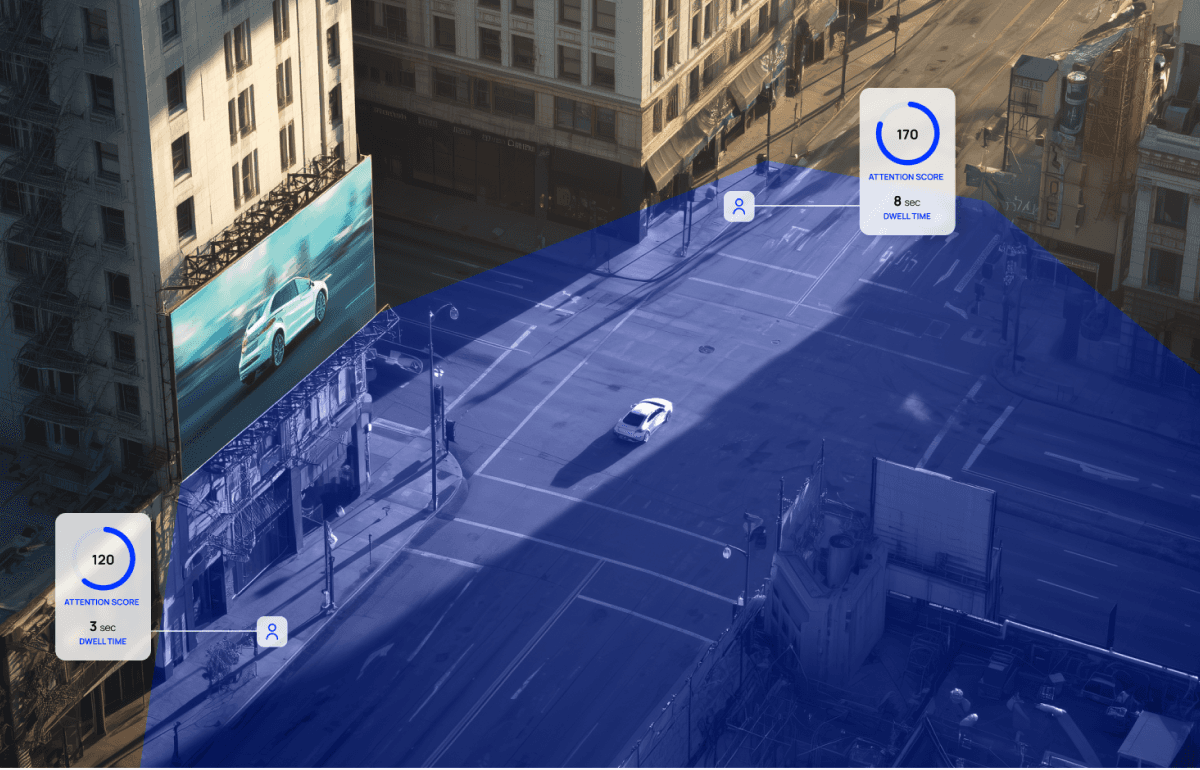
The approach analyzes how an advertisement stands out within its surrounding environment and how likely it is to draw the viewer’s eye from different vantage points. By examining both the media unit and its context, the model provides a standardized metric for comparing performance across formats, placements, and markets.
This perspective opens the door to a new layer of campaign insight:
Which placements naturally attract attention within complex urban environments
How creative design influences what audiences notice first
Why certain units outperform others despite similar impression volumes
Where advertisers can optimize placements to improve engagement
The Role of Visual Science
Human vision processes scenes selectively. Our eyes scan environments rapidly, prioritizing areas that contain greater visual contrast and complexity.
This dynamic helps explain why certain advertisements immediately stand out while others blend into the background. Elements such as color contrast, visual hierarchy, and environmental context all influence where attention is directed within a scene.
These concepts from visual processing and information theory can be applied to OOH media. By analyzing visual complexity in a streetscape, it becomes possible to predict where attention is most likely to focus, and how advertising elements can be positioned to capitalize on those moments.
Turning Insight Into Strategy
Attention-based analytics extend beyond measurement. They provide a foundation for improving how campaigns are planned and executed.
Advertisers can use attention insights to evaluate the relative strength of media placements, refine creative design, and compare performance across markets. Our Creative Optimization tool also allows teams to test different visual approaches and assess how effectively key elements, such as logos, product imagery, or calls to action, draw viewer attention.
These capabilities support more informed decisions throughout the campaign lifecycle, from media selection to creative development and post-campaign evaluation.

The Next Evolution of OOH Measurement
As the media landscape evolves, advertisers are seeking metrics that capture real engagement while remaining compliant with emerging privacy standards.
Attention-based analysis offers a way to evaluate campaign effectiveness by examining observable interactions among advertising, the environment, and audience behavior. By focusing on how ads compete within real-world visual contexts, advertisers gain a clearer understanding of which placements truly stand out.
For brands investing in OOH, attention provides a new lens for measuring impact.
Explore the Full Research
This article introduces only a portion of the framework.
The full whitepaper explores the methodology behind the Attention Score in greater depth, including the science of visual processing, the technology used to analyze media environments, and practical applications for campaign planning and creative optimization.
Download the whitepaper:
Attention Score Unlocked: A Data-Driven Guide to OOH Excellence
Our news