The new shape of specialist OOH
Introduction
Date
Author
billups
Type
Articles

What one of WOO London's most revealing conversations tells us about where the industry is heading.
You can tell a lot about an industry by the questions it asks itself out loud. One of the most interesting discussions at this year's World Out of Home Organisation Global Congress in London wasn't about whether out-of-home matters. That argument feels settled.
Beyond the conference sessions, the debate continued in hallways, coffee breaks and evening receptions. The mood was notably optimistic. The questions being asked were less about whether OOH has a future and more about how the industry should evolve to meet rising expectations around accountability, technology and business outcomes.
The harder, more interesting question running through the week was about shape: what should the businesses that plan and buy OOH actually look like now that automation, data and client expectations are all evolving at once?
Nowhere was that clearer than in the Friday afternoon session on the future of the specialist buying model — a panel of independent and holding-company leaders exploring what specialism really means in 2026, and what it will be worth in five years' time.
From buying billboards to building a point of view
For years, the OOH specialist was understood as a buyer — a desk that turned a budget set elsewhere into a schedule of sites. The panel was almost unanimous that this definition has had its day. The value now sits in judgment, not transaction.
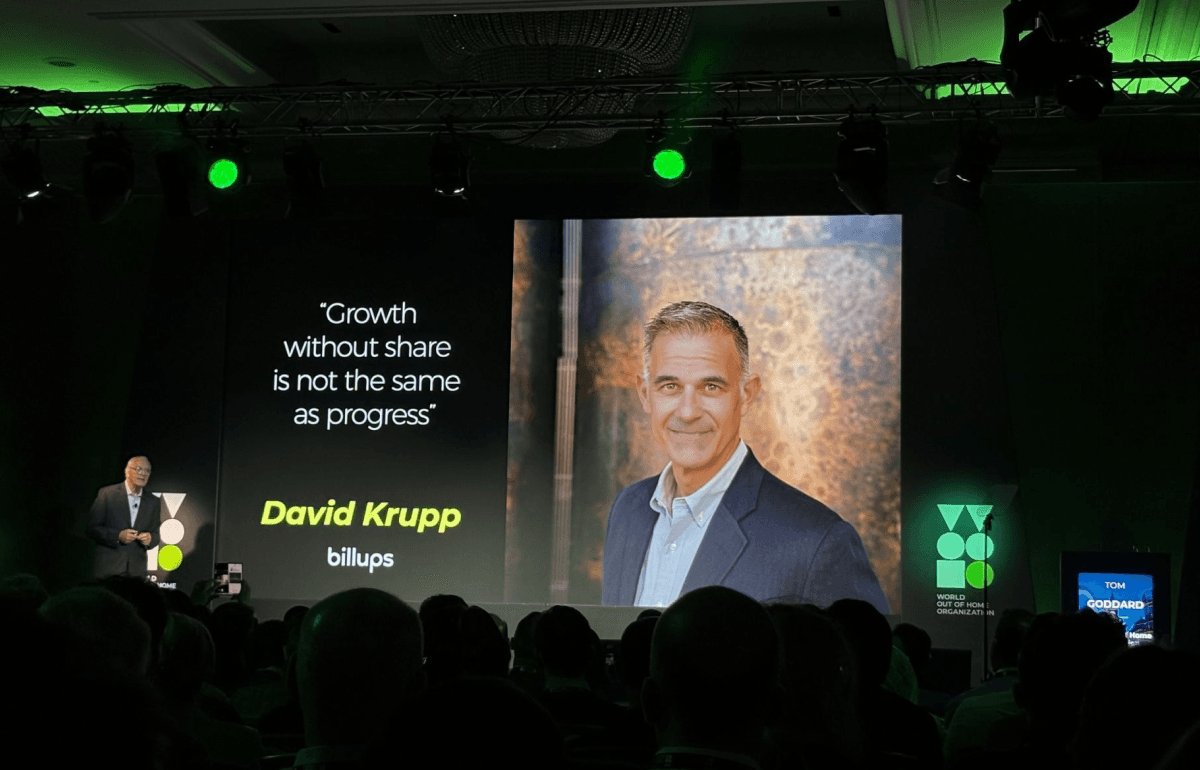
David Krupp, Global CEO at billups, framed independence as the thing that makes that judgment possible:
“Value from our perspective is around focus. We do one thing and we are experts at doing one thing — through a flexible and adaptable lens, we can work with any DSP, we can work with any data provider. We don’t have that built-in ecosystem that we have to be adherent to.”
It’s a distinction with real consequences for clients. A specialist shaped by a parent company, he argued, is inevitably shaped by that parent’s economics and priorities too. An independent one can optimise for the medium itself — and, increasingly, for what the medium actually does to the people who encounter it.
Accountability is no longer optional
If there was a single word the room kept returning to, it was accountability. OOH has historically been bought on relationships and hard-won instinct. That expertise still matters — but it is no longer the whole story.
“Today data is helping us make better informed decisions faster, and it’s also allowing us to challenge the conventions that clients sometimes bring us. We’re able to up-skill ourselves to go from being buyer-planner to consultative support, helping them make smarter business decisions.”
That shift — from executing a brief to questioning it — is what separates a supplier from a partner. And it is increasingly underwritten by measurement.
Krupp pointed to billups’ investment in understanding not just whether a campaign worked, but how each individual board contributed to a specific outcome:
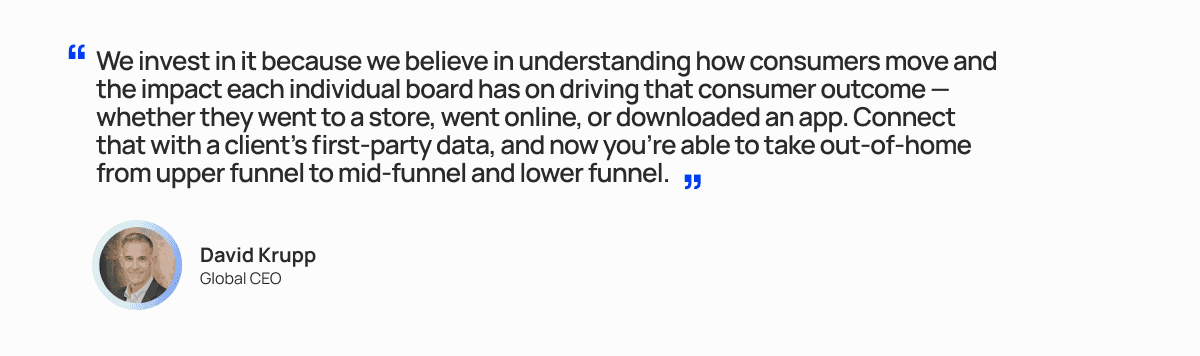
That last point is quietly significant. An industry long treated as a top-of-funnel awareness play is making a credible case for the middle and bottom of the funnel too — not by claiming it, but by measuring it.
Automation handles the 80%. People are the 20% that matters.
Inevitably, the conversation turned to AI — but the framing was refreshingly practical. The interest wasn’t in automation as spectacle. It was in what automation frees people to do.
Krupp described billups’ own approach in terms of where machine work ends and human expertise begins:
“It builds the plan, it builds the presentation, it does the heat mapping and the plotting … if we can make that automated and help them get to the 80% of the right answer, that 20% of human experience and market knowledge helps shape a plan very, very quickly and very elegantly.”
The point being made across the panel was consistent: technology scales the routine so that local knowledge, relationships and strategic instinct — the genuinely human parts of the job — can be spent where they actually move the needle. Automation, in this telling, isn’t what replaces the specialist. It’s what lets the specialist get out from behind the desk and back into the market. Similar themes ran through the Congress more widely, with automation, measurement and the evolving role of specialist expertise recurring across sessions throughout the week.
A people-to-people medium, at global scale
For all the talk of data and AI, the week was a reminder that OOH remains stubbornly, valuably human. It is a medium of physical places, local regulation, individual media owners and on-the- ground relationships — one that resists being run entirely from a dashboard. It was a theme that surfaced repeatedly across the Congress, well beyond any single session: managing OOH well across markets demands cultural fluency as much as technical capability, and an understanding that a campaign in one country cannot simply be copied into another.
That tension — global scale on one side, deep local expertise on the other — is precisely where independent specialists argue they earn their place. Not by choosing between the two, but by holding both at once.
Where this leaves us
The specialist of the next five years looks less like a buyer and more like a consultant: independent enough to be objective, technical enough to be accountable, and human enough to know that the final, decisive part of the work still belongs to people.
As OOH continues to prove its value across the funnel, the question is no longer whether the medium belongs in the plan. The challenge now is building the specialist models, technologies and capabilities that allow it to perform at its full potential.
Our news