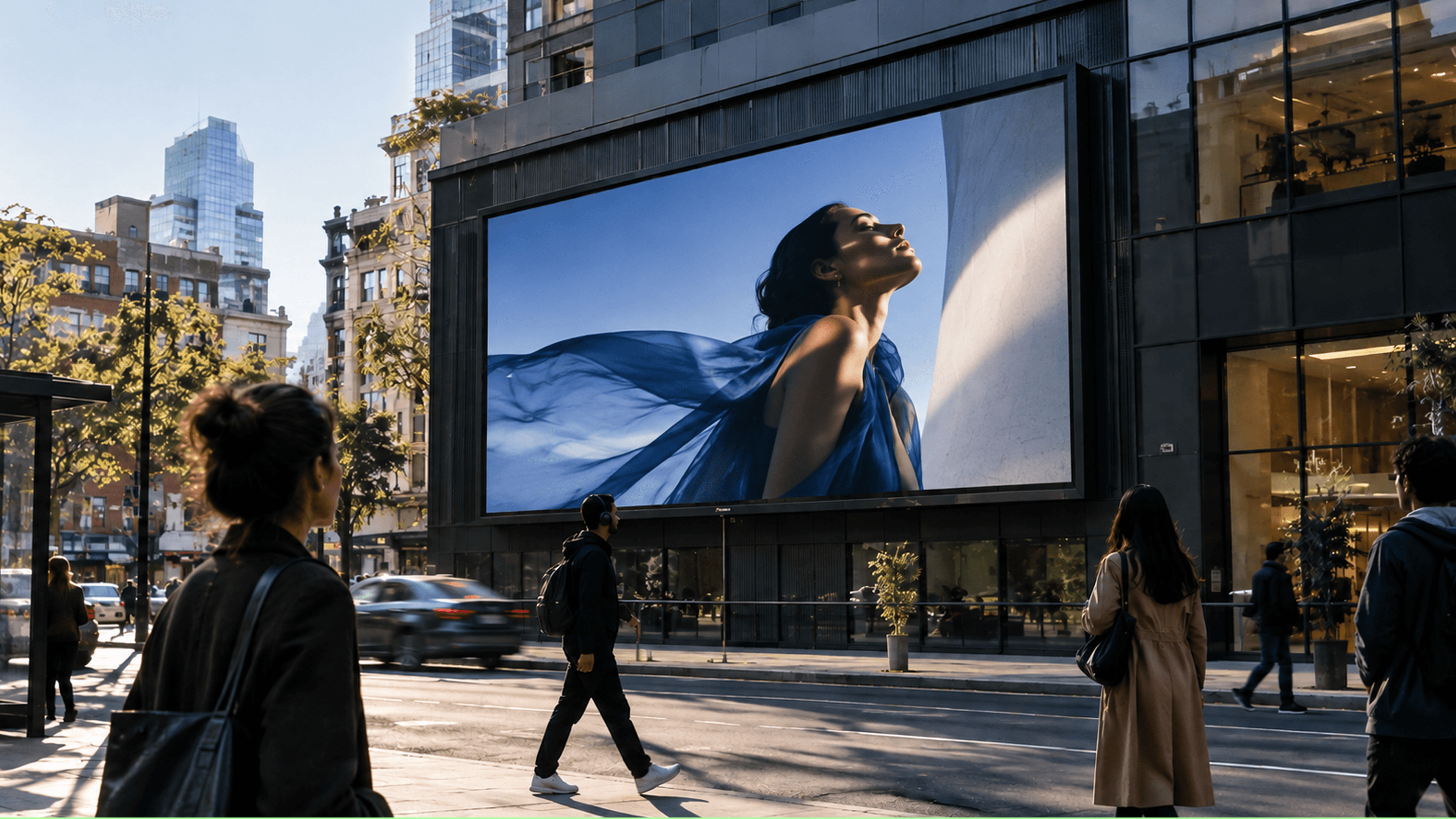
From Automation to Amplification: How AI is Redefining Creativity in Out-of-Home
Introduction
Date
Author
billups
Type
Articles

Let’s be honest, the AI talk is exhausting. Every headline screams the same thing: robots taking jobs, algorithms stealing imagination. It’s easy to tune out.
But at billups, we started wondering something quieter, what if AI could actually give us our work back?
And the numbers feel huge: for example, the global “AI in marketing” market is projected to hit about US $47.3 billion in 2025, up from roughly $12 billion in 2020.
But here’s the thing, that’s not the story that kept us up at night. We kept asking:
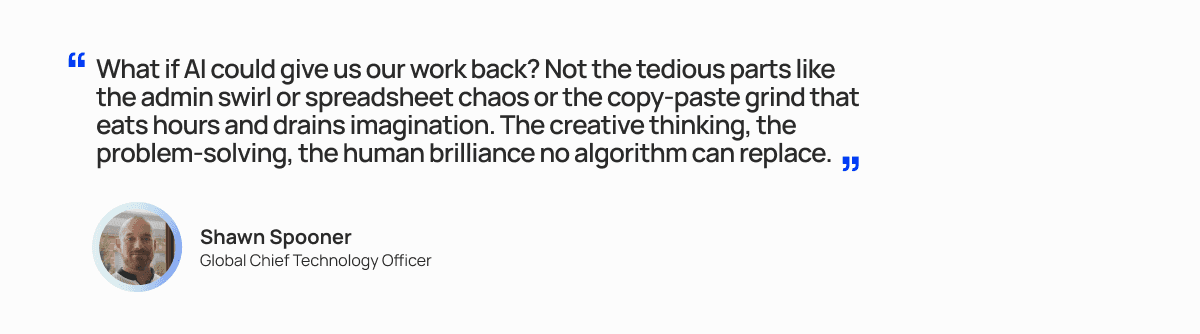
According to a 2024 report, 71% of organizations now say they regularly use generative AI in at least one business function and marketing/sales continues to be one of the leading areas of adoption.
That’s where humans shine. It’s what we call the zone of human brilliance. Every tool we build has to answer one simple question before it ships: Does this keep our people there?
Table of contents
AI and Advertising: Beyond the Hype
Why Out-of-Home Needs Its Own Kind of Intelligence
billups and the Future of Intelligent OOH
audrai: Built for the Way billups Works
The bigger picture
Key Takeaways
AI is everywhere, but context is everything. The next era of advertising will belong to companies that turn intelligence into insight, not noise.
OOH deserves its own AI. Out-of-Home is built on human instinct; the right technology should amplify that, not automate it.
billups is defining the standard for intelligent OOH. From creative attention modeling to audience intelligence, we’re building connected systems that make the work faster and the thinking sharper.
audrai™ is proof of that vision. Purpose-built for OOH, it shows what happens when AI gives people their time and their joy back.
Amplification over automation. The real promise of AI isn’t to replace people but to return them to the work that matters most.
AI and Advertising: Beyond the Hype
Across advertising, “AI” fills every deck and dominates every panel. It’s either the saviour of marketing or the villain of creativity. But somewhere between those extremes lies the real story.
Advertising was already data-driven long before AI entered the chat. In fact, 65% of organizations now say they regularly use generative AI, nearly double the share reported just ten months earlier. And according to the Marketing AI Institute’s 2024 State of Marketing AI Report, 99% of marketers are using AI in some capacity, with 36% integrating it into daily workflows. What changed was the volume. Dashboards multiplied. Tools promised “intelligence” but mostly delivered noise.
The problem wasn’t more data. It was better context. Teams were drowning in dashboards, juggling tools that promised “intelligence” but delivered noise.
When AI works, it doesn’t make more noise. It quiets it. It connects data to decisions. Patterns to purpose. Speed to strategy. And suddenly, the work feels sharper and a little more human again.
The trouble? Too much of today’s AI is generic, a thin layer over a language model, dressed up in a slick UI. It automates outputs, not outcomes. It can summarize a brief but can’t understand why one corner of London moves people more than another.
Because advertising isn’t generic. It’s contextual. It’s emotional. It’s human. And nowhere is that truer than in Out-of-Home.
Why Out-of-Home Needs Its Own Kind of Intelligence
Out-of-Home (OOH) has always lived where data meets instinct.
Yes, we can model footfall and dwell time, but OOH is about feeling the street and knowing which wall becomes a landmark, which corner hums with the morning rush, which mural becomes a city’s backdrop.
That kind of insight doesn’t come from a spreadsheet; it comes from the people who know the rhythm of a city.
And that’s where technology can do its most human work amplifying intuition, not replacing it.
Because the problem in OOH isn’t a lack of ideas. It’s a lack of time. Brilliant concepts die in the cracks between research and execution. Planners spend more time stitching data than shaping strategy.
Recent industry research shows the average global marketing team now uses over nine different data and planning tools for campaign delivery, yet less than a third say those tools actually talk to each other. That fragmentation costs creative momentum and, ultimately, attention.
Meanwhile, the scale of OOH keeps growing. Global ad spend on outdoor media surpassed $42 billion in 2024 and with that growth comes even more complexity new formats, data streams, and channels demanding smarter, faster decisions.
billups saw the pattern early: OOH didn’t need more tools. It needed a connected intelligence layer, one that keeps the magic of human planning but removes the manual grind.
So we built toward that future.
billups and the Future of Intelligent OOH
billups has always believed that Out-of-Home should be as measurable, responsive, and intelligent as any digital channel, but never at the expense of creativity.
For more than a decade, we’ve been building the infrastructure to make that possible:
Real-time audience intelligence that connects behavior to place.
Creative attention modeling that predicts what people actually see and feel.
Integrated planning platforms that unite discovery, data, and delivery.
Together, these capabilities form a new standard for what intelligent OOH can be, a space where brands can plan globally, act locally, and measure with confidence.
At the heart of that vision is a simple principle: technology only matters when it makes people more effective and more fulfilled. Every new tool we create, every dataset we integrate, and every partnership we pursue is designed around one purpose: to keep our teams and our clients in the zone of human brilliance. Because when people have time to think, create, and connect, the entire industry moves forward.
And that belief is exactly what led us to build audrai, a system that takes everything billups has learned about Out-of-Home and turns it into something powerfully human-centric.
audrai™: Built for the Way billups Works
audrai isn’t the headline; it’s the proof point. It’s what happens when you take billups’ deep industry knowledge and encode it into a system built to think like Out-of-Home.
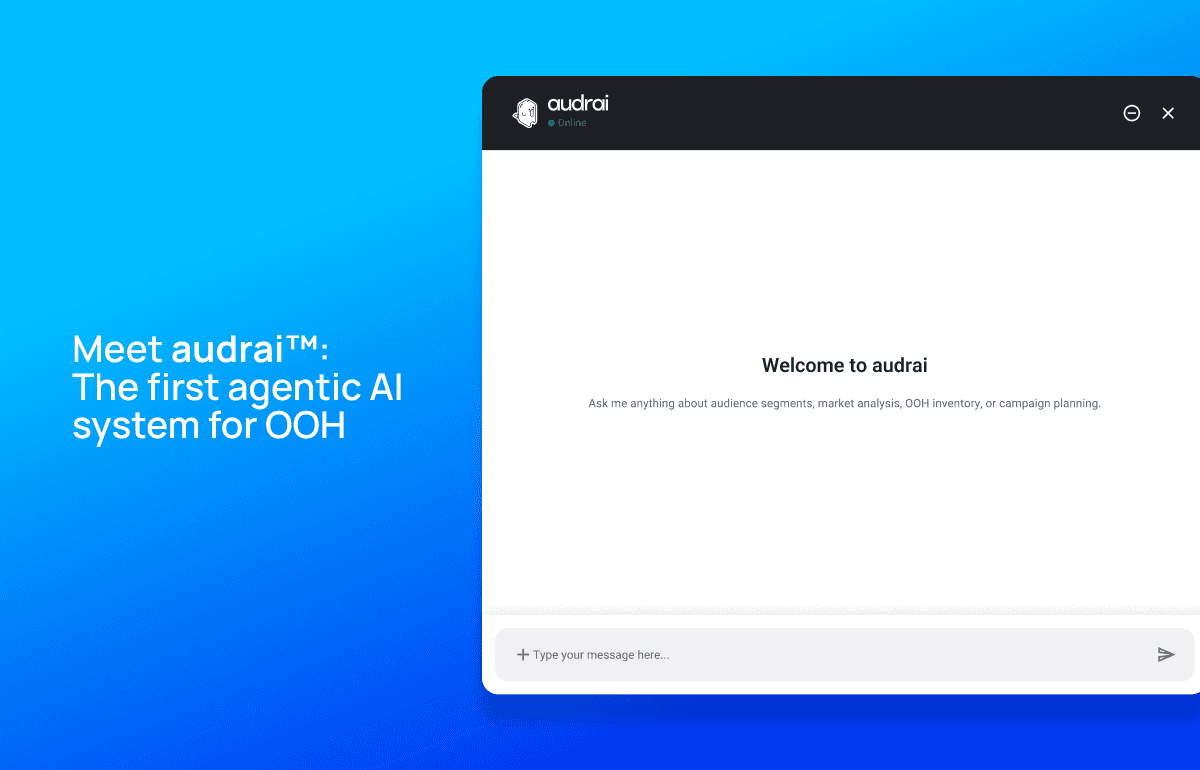
A purpose-built agentic AI system, audrai speaks the language of locations, audiences, and formats. It helps our planners and partners see possibilities faster, map smarter, and measure what actually matters.
Unlike most tools, audrai isn’t a single model trying to do everything. It’s an agentic system that brings together multiple AI models, including Gemini, Claude, and our own internal intelligence tools, to handle complex, multi-step workflows that reflect how OOH planning really happens.
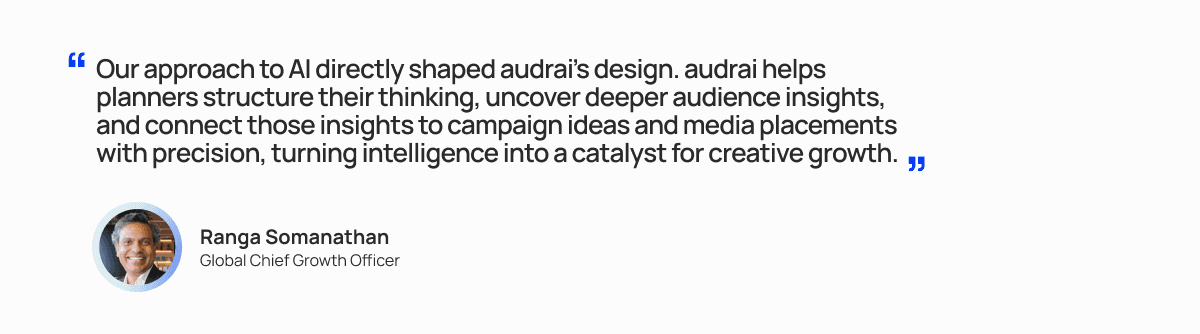
You can almost feel it at work, that moment when a cluttered dashboard becomes a clear city map, glowing softly on a planner’s screen, like the hum of traffic under a morning billboard.
audrai connects data with instinct. It gives context, meaning, and helps our teams turn insight into action without losing the creative thread that makes great work possible.
And we’re already seeing the results. Across global billups teams, workflows have accelerated by up to 50%, and mapping that used to take two days now takes two minutes.
In some markets, audrai has even reduced manual proposal and research time by as much as 80%; hours that used to disappear into spreadsheets are now going toward ideas, relationships, and the kind of creative thinking you can’t automate.
That’s what audrai is all about: freeing people to do more of the work that feels alive.
Because at its best, AI doesn’t just make things faster. It gives people their time and their spark back.
The Bigger Picture
Technology has always reshaped advertising from the printing press to programmatic, but every leap raises the same question: Does it make us better, or just faster?
Our answer: both, when you build it right.
At billups, our North Star isn’t automation, it’s amplification. We’re not asking how much work technology can take away. We’re asking how much life it can give back.
Because when technology finally feels like it’s on your side, something shifts. The noise quiets down. The spark comes back. And suddenly, work doesn’t just feel productive, it feels alive again.
That’s what amplification really means. It’s not about replacing hands or minds. It’s about giving them room to stretch, to play, to think beyond the dashboard.
audrai is one expression of that belief, but it’s just the beginning of a larger movement: billups building the future of intelligent, human-first OOH.
We build for the thinkers and the doers, the ones who still walk down city streets looking up instead of down. Because when technology gives people their spark back, the world outside starts to look different. You notice the walls again. The light. The stories in motion. The human fingerprints behind every billboard.
That’s the future we’re chasing, not colder or faster, but more awake. More alive. More human.If you’re ready to see what happens when creativity meets intelligence, explore what’s possible with Out-of-Home and the technology behind it. Discover how billups and audrai can help you plan smarter, think bigger, and create work that truly connects out there, in the world we share.
Our news