What’s next in Programmatic Out-of-Home: Measured, Not Described
Introduction
Date
Author
billups
Type
Articles
The conversation around Programmatic Out-of-Home has gone on long enough.
Not because the channel lacks potential, but because too much of the discussion has remained focused on what it is, rather than why it’s being used. For many teams, that imbalance has created more uncertainty than confidence. Everyone knows Programmatic OOH exists. Far fewer feel clear on how it fits into real-world planning decisions.
As we navigate through 2026, Programmatic OOH is no longer about innovation for its own sake. It is about execution. The brands seeing real value are not chasing buzz or new terminology. They are using the channel deliberately, aligning it with a broader Out-of-Home strategy, and focusing on solving specific business problems often without much noise at all.
That shift toward clarity has also exposed an uncomfortable truth: as capabilities have matured, complexity has become more of an obstacle than an advantage.
“Programmatic OOH has been around far longer than people think. What’s relatively new is the consistent, disciplined way it’s being used.” said Alex Grieves, Global Head of Programmatic at billups.
Long before Programmatic became mainstream or fully integrated into the media mix, early forms of automated, data-informed OOH buying began to emerge, shaped by the rise of smartphones and the way people increasingly moved through and interacted with the physical world.
What’s changed since then is not the underlying capability, but the expectations around how it should be used.
That understanding extends beyond use cases to language itself.
“We don’t need another acronym,” Grieves said. “It’s just OOH delivered Programmatically. If I can’t explain it to my mum, there’s a problem.”
(And most people reading this have sat through at least one presentation that failed that test.)
That growing insistence on plain language and clear purpose is where the momentum truly comes from.
Table of Contents
Growth is happening, even if it doesn’t always feel that way
From siloed capability to joined-up execution
Lower barriers and lower risk for smaller advertisers
Programmatic supports OOH; it does not replace it
Myths vs. facts: where confusion still creeps in
How teams are using programmatic OOH well in practice
Data only helps if you act on it in time
What 2026 actually looks like
From conversation to capability
Key Takeaways
Programmatic OOH isn’t new; disciplined use is
The capability has existed for years. What’s changed is how deliberately it’s being applied within real OOH planning frameworks.
Growth matters less than how teams are structured
The biggest shifts are organisational: Programmatic and OOH expertise coming together to solve planning problems, not just enable buying.
Audience delivery must be intentional, not implied
Programmatic’s real value lies in activating against defined audiences with control over timing, context, and conditions, not in automation for its own sake.
Accessibility is redefining who can use OOH
Lower entry points and selective activation are opening the channel to advertisers previously priced out of traditional models.
Programmatic complements scale, it doesn’t replace it
Traditional OOH delivers presence and consistency. Programmatic adds flexibility and responsiveness. The strongest strategies use both.Data only creates value when acted on mid-flight
Measurement after the campaign is no longer enough. The advantage comes from adjusting while outcomes can still change.
2026 is about evidence, not explanations
Fewer buzzwords. More third-party measurement. Clear answers to clients’ “so what?”
Growth is happening, even if it doesn’t always feel that way
OOH continues to demonstrate resilience in a fragmented media landscape. Global OOH advertising revenue surpassed $9.1 billion in 2024.
Within that broader expansion, Programmatic OOH continued to grow unevenly across markets. In the United States, the Programmatic OOH market was expected to post the fastest compound annual growth rate globally, at approximately 29.5% between 2024 and 2030. That growth was driven in large part by the ongoing digitization of outdoor infrastructure, including the expansion of digital billboards, transit displays, and interactive screens, which widened the range of environments available to advertisers.
The acceleration was also shaped by structural shifts following the COVID-19 pandemic. Increased time spent outside the home, greater emphasis on local experiences, and improved operational flexibility made Digital OOH more attractive to brands seeking reach without overreliance on traditional digital channels.
What matters more than perfect numbers is what is changing beneath them: how teams are structured, how inventory is accessed, and how decisions are made.
And it is those internal shifts, not topline growth figures, that are quietly reshaping how programmatic OOH is planned and executed.
From siloed capability to joined-up execution
One of the most meaningful shifts in programmatic OOH is organizational rather than technical.
For years, the channel sat in an awkward middle ground. Programmatic buying and OOH planning evolved along separate paths, meaning few teams had the combined expertise needed to apply automation effectively within an OOH context. Capability existed, but it was siloed and rarely brought together in a single planning process.
“Programmatic OOH used to sit siloed, either inside a programmatic team with no OOH knowledge, or the other way around,” said Alex Grieves. “Now you’re seeing those teams come together, and that’s what’s enabling better planning.”
That convergence has changed the nature of planning conversations. Instead of asking whether something can be bought programmatically, teams are increasingly asking whether it should be and what problem it is meant to solve.
That same shift in thinking also helps explain why Programmatic OOH is starting to feel more accessible to a wider range of advertisers.
Lower barriers and lower risk for smaller advertisers
Accessibility remains one of the most practical benefits of programmatic OOH.
Traditional OOH has long been associated with large budgets, long lead times, and broad coverage. Even where that is no longer strictly true, the perception has lingered particularly around flexibility leaving many smaller advertisers to view OOH as a higher-risk commitment than other channels, where budgets can be adjusted or withdrawn with far less financial consequence. Even where that is no longer strictly true, the perception has lingered, leaving many brands to view OOH as a higher-risk commitment than other channels.
“Not every brand has £200,000 a week,” said Alex Grieves, Global Head of Programmatic at billups. “Some have £10,000 for the year and one store. Programmatic OOH lets them focus on exactly where they need to be, visible to the right audience.”
Alex Grieves recently described working with a local advertiser whose goal was simply to drive footfall to a single location during a short trading window. There was no appetite for a national buy or long-term commitment, just a need to be visible in the right place, at the right time. Programmatic enables that focus without unwanted and costly forced extra scale.
No headline. No hype. Just a job done efficiently.
That kind of flexibility, however, only works when Programmatic is seen as a complement to Out-of-Home, not a replacement for it.
Programmatic supports OOH; it does not replace it
One misconception still surfaces regularly: that Programmatic OOH competes with traditional formats.
“They’re not competing,” said Alex Grieves. “They’re on the same team. They just provide different solutions for different challenges.”
Traditional OOH delivers scale, presence, and consistency. Programmatic execution adds flexibility, enabling campaigns to activate against defined audiences, respond to real-world conditions, and optimise delivery.
Research shows multi-format, multi-channel campaigns outperform single-channel approaches by up to 35%. The real opportunity lies in strengthening OOH’s overall role in the media mix, not pitting buying methods against one another.
Many of the remaining challenges around adoption stem not from capability, but from lingering misconceptions about what Programmatic OOH is and what it is not.
Myths vs. facts: where confusion still creeps in
As adoption grows, a few misconceptions continue to slow progress.
Myth: Programmatic OOH delivers instant performance like paid social
Fact: OOH remains a brand and demand-driving channel. Programmatic adds flexibility and responsiveness, not short-term click metrics.
Myth: More data automatically means better results
Fact: Data only matters when it informs decisions before and during campaigns, rather than being reviewed after the fact as a box-ticking exercise.
Myth: Programmatic OOH is too complex to explain internally
Fact: When stripped of jargon, it is simply OOH delivered programmatically with more control over timing, location, and conditions.
In practice, overcoming these misconceptions often comes down to how teams plan and operate day to day.
How teams are using programmatic OOH well in practice
The most effective applications tend to follow a similar pattern:
Start with the business goal, not the buying method
Brand awareness, consideration or preference, market share, footfall – clarity comes first.
Use Programmatic selectively where appropriate, not universally
It complements traditional OOH; it does not replace it.Plan for flexibility from the outset
Budgets, triggers, and timing are designed to move.Monitor performance while campaigns are live
Adjustments are made when they still matter.Measure outcomes, not just delivery
Exposure is table stakes. Impact is the goal.
It sounds simple, and that’s the point.
One example of this execution-first approach can be seen in a campaign designed to strengthen brand leadership rather than chase short-term visibility.
Working with Nivea, billups used Programmatic OOH to activate contextually relevant placements aligned with moments of heightened audience attention. Rather than relying on scale alone, the campaign focused on selective environments and timing, allowing creatives to work harder within fewer, more meaningful exposures.
The result was not just visibility, but reinforcement of brand authority in environments that supported the message. Programmatic flexibility allowed delivery conditions to be adjusted in real time, ensuring investment stayed aligned with intent rather than running on autopilot.
It is a useful reminder that when Programmatic OOH is applied with restraint and clarity, it does not dilute brand building; it strengthens it.
Data only helps if you act on it in time
“Before Programmatic, you’d run a campaign and only really understand what happened at the end,” said Alex Grieves. “If something wasn’t working, it was too late.”
Programmatic OOH changes that dynamic.
“Now you can see it weekly, daily, even hour by hour, and actually do something about it,” he said.
That ability to act mid-flight allows teams to respond to real-world inputs such as weather, inventory availability, or operational constraints. According to Gartner, brands that activate data during execution rather than only during planning can achieve 20% to 30% improvements in media efficiency.
As data becomes more actionable, the way the industry talks about programmatic OOH also matters.
What 2026 actually looks like
If you’ve read this far, here’s the reality check.
Rather than bold predictions or shiny new frameworks, 2026 looks refreshingly unglamorous. It looks like proof.
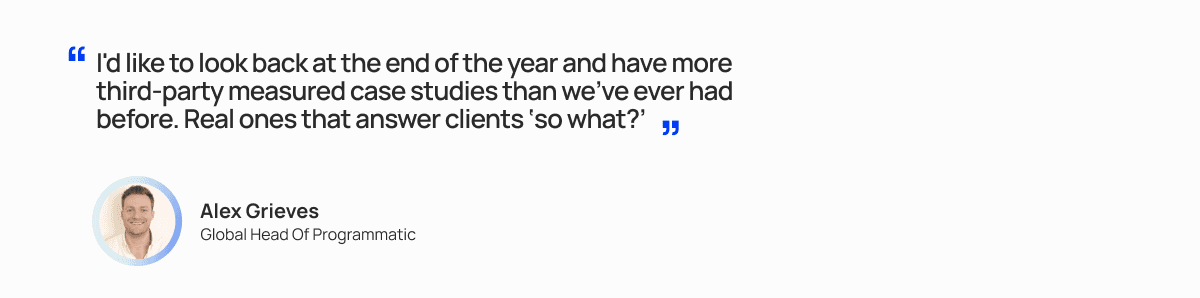
“I'd like to look back at the end of the year and have more third-party measured case studies than we've ever had before” said Alex Grieves, Global Head of Programmatic at billups. “Real ones that answer clients’ ‘so what?’”
That means outcomes over impressions. Smarter use of data while campaigns are live, not after they end. Creative that responds to context rather than running on autopilot. Inventory made available with intent, not just because it can be.
With global ad spend expected to surpass $1 trillion by 2026, digitally enabled channels are set to capture most incremental growth. Programmatic OOH is positioned to play its part, not as a headline-grabber or a talking point, but as a dependable, grown-up component of modern media planning.
In other words, less noise. More evidence. And far fewer excuses.
From conversation to capability
As we move through 2026, Programmatic OOH is settling into something more useful than hype.
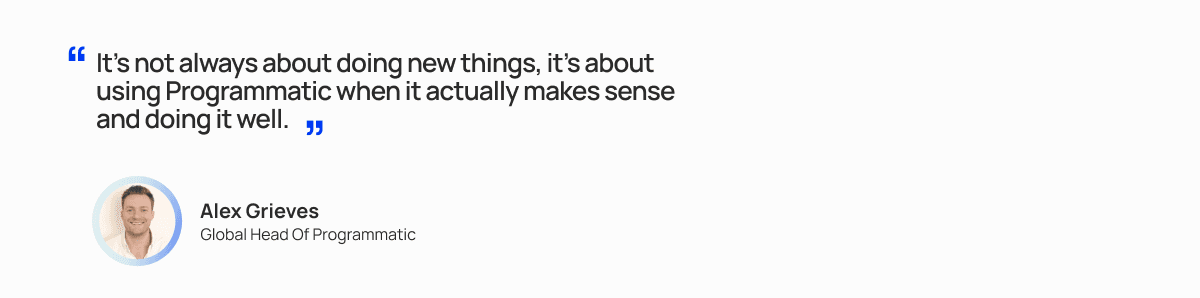
“It’s not always about doing new things,” said Grieves. “It’s about using Programmatic when it actually makes sense and doing it well.”
The question is no longer whether Programmatic OOH belongs in the conversation. It is whether it is being used with purpose. And for teams looking to understand where programmatic can genuinely add value and where it should not, getting in touch with billups may be the next step in seeing how disciplined execution can take OOH further.
Our news