Out-of-Home Advertising in Singapore: A Market Overview
%201.png)
Out-of-Home Advertising in Singapore: A Market Overview
Singapore’s Out-of-Home (OOH) advertising ecosystem stands out for its structure, innovation, and ability to deliver strategic impact. Unlike markets where media planning requires navigating clutter or inconsistencies, Singapore’s well-regulated landscape and concentrated vendor base enable brands to focus on story, placement, and audience precision.
Whether it’s dominating in high-stakes transport hubs like Changi Airport or tailoring creative to hyper-local audiences across public transport, this is a market built for thoughtful media and big results.
This overview draws on insights from Angie Cutter, Head of Client Development & Partnerships, APAC, and Ranga Somanathan, Global Chief Strategy Officer from billups, who offer a front-line view into Singapore’s uniquely structured OOH landscape.
Key Takeaways
- Singapore’s OOH market is structured and reliable, making it ideal for precision-led campaigns and high creative standards.
- Changi Airport is a media powerhouse, offering international brands premium reach with over 67 million annual passengers.
- Digital formats command 40% of total OOH revenue, driven by increasing demand for dynamic and programmatic opportunities.
- Audiences are affluent, mobile, and culture-conscious, making psychographic targeting and localization essential.
- Luxury, cosmetics, fintech, FMCG brands and government campaigns are leading growth, especially across transit, malls, and digital formats.
Table of Contents
- A Market Built for Clarity and Strategy
- Small Land, Massive Reach
- Changi Airport: Singapore’s OOH Crown Jewel
- Digital, Data, and Design in Action
- Who’s Watching and Where
- Growth Sectors and Campaign Playbooks
- What’s Next
1. A Market Built for Clarity and Strategy
Singapore is one of the most organized OOH markets in Asia. With just four major vendors and a tightly governed approval process, advertisers gain access to consistent formats and stable media inventories minus the chaos.
“We don’t need to chase down wild billboards. Everything follows standards, from sizes to locations,” says Cutter. “That allows us to spend our creative energy on storytelling, not troubleshooting.”
This predictability becomes a competitive advantage. Clients can focus on campaign design and performance, knowing placements will deliver consistently.
2. Small Land, Massive Reach
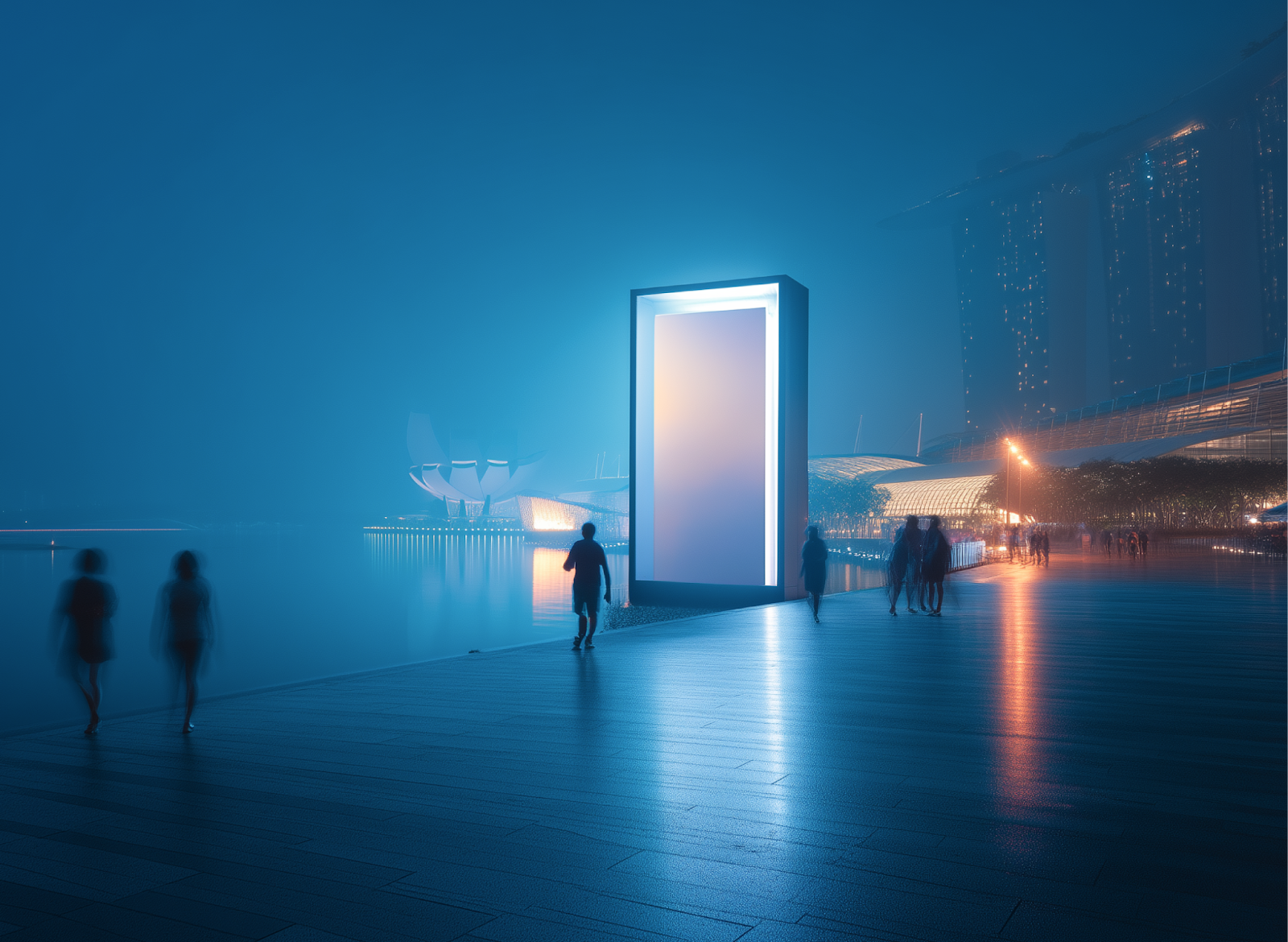
Despite being a city-state of just 6 million residents, Singapore’s OOH footprint punches far above its weight. Why?
Changi Airport alone welcomed 67.7 million passengers in 2024, making it a global transit hub with dwell-rich inventory and high visibility.
Events like the F1 night race, global concerts (like Taylor Swift's only Southeast Asia stop), and year-round conferences also transform premium shopping precincts into internationally visible stages.
As Somanathan puts it: “Singapore's condensed geography and urban density mean a strategic, well-placed advertisement can deliver massive impact.”
3. Changi Airport: Singapore’s OOH Crown Jewel
Changi is an OOH platform with prestige. Regularly voted the world’s best airport, it offers brands access to international business travelers, luxury shoppers, and digital natives alike.
With over 67 million travelers in 2024, its audience far exceeds the country’s population. OOH formats range from high-tech LED walls to immersive corridor takeovers, with major global brands frequently activating in both arrivals and departures.
Recent campaigns include luxury brand launches, tech product reveals, and multi-screen displays from finance, beauty, and travel sectors. With long dwell times and a high concentration of decision-makers, Changi remains a media planner’s dream.
4. Digital, Data, and Design in Action
Singapore has leaned into digital OOH at pace. Nearly 40% of all OOH revenue in 2024 came from digital formats, according to a report by Dentsu. Most of these appear in transit zones, shopping malls, and building facades rather than roadside megastructures, due to strict building codes.
While you won’t find Times Square-style digital explosions here, creativity thrives in underground stations, bus shelters, and retail takeovers.
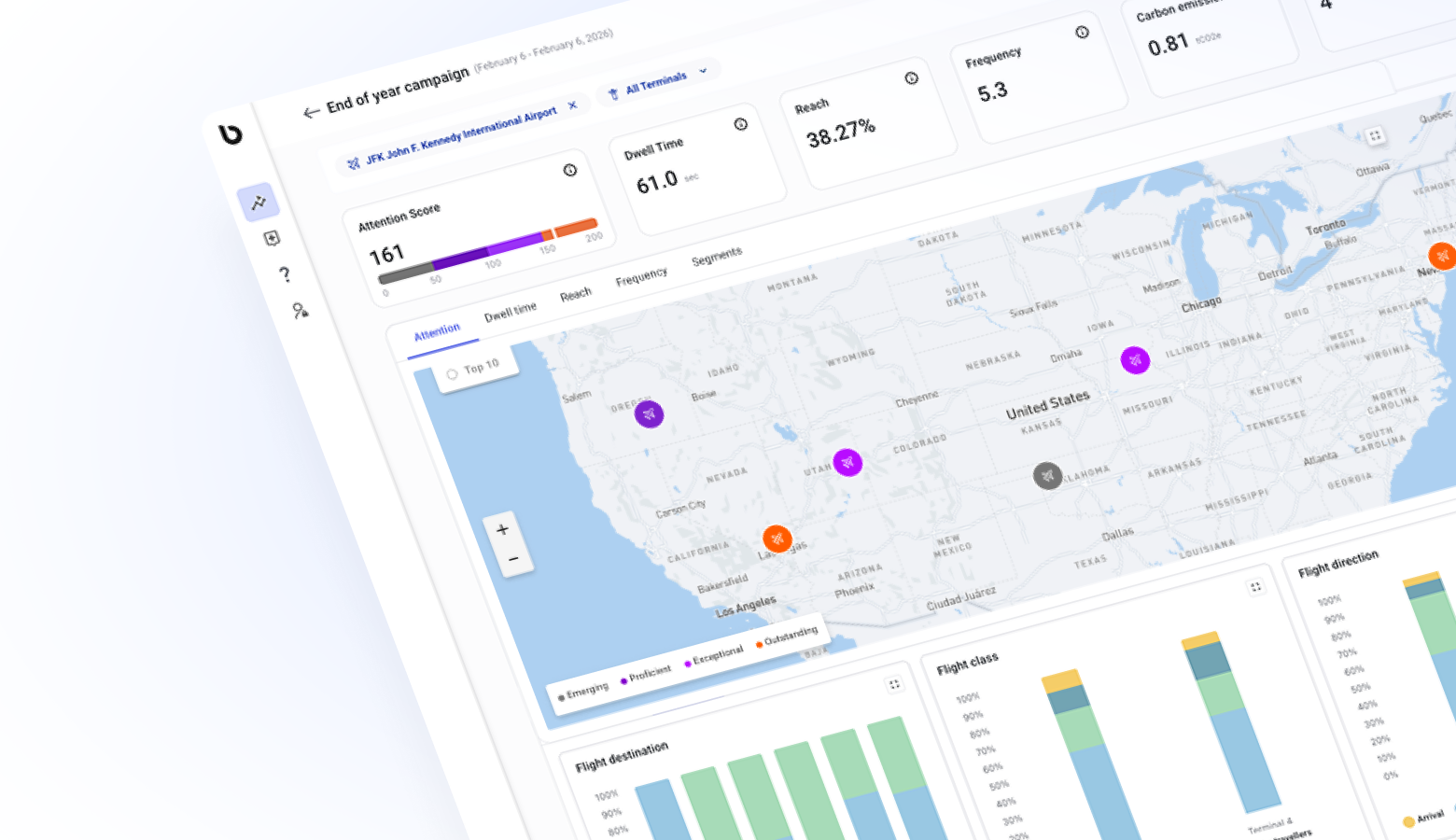
billups supports clients by combining location data, audience insights, and real-time analytics. “We’ve built a full-stack strategy offering,” Cutter says. “From static placements to dynamic programmatic buying, we map audiences to formats that drive behavior.”
Programmatic is growing, but slower than in Western markets. Part of billups’ mission is to educate media owners about its value while preserving premium pricing models.
5. Who’s Watching and Where
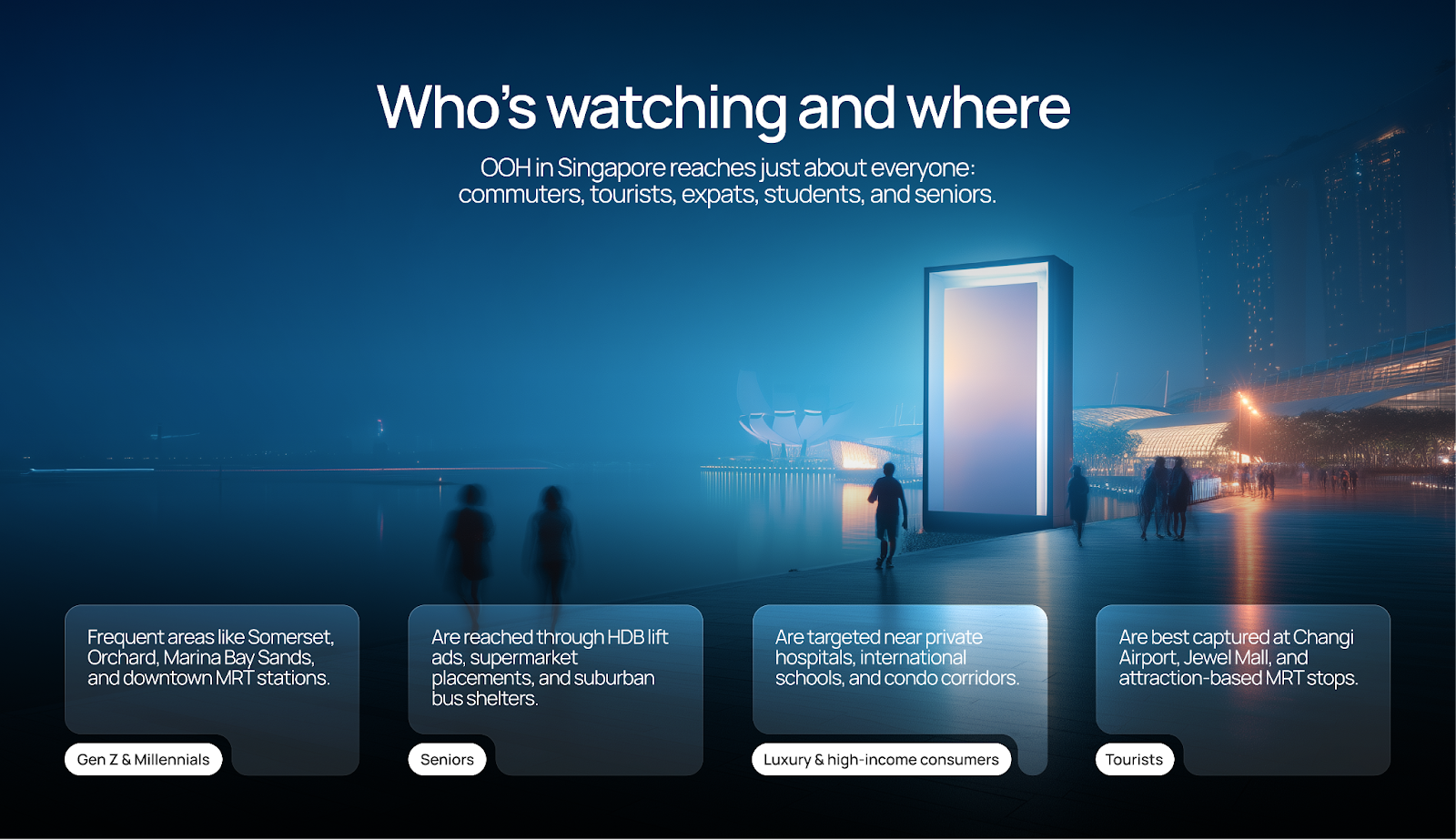
OOH in Singapore reaches just about everyone: commuters, tourists, expats, students, and seniors.
- Gen Z and Millennials frequent areas like Somerset, Orchard, Marina Bay Sands, and downtown MRT stations.
- Seniors are reached through HDB lift ads, supermarket placements, and suburban bus shelters.
- Luxury and high-income consumers are targeted near private hospitals, international schools, and condo corridors.
- Tourists are best captured at Changi Airport, Jewel Mall, and attraction-based MRT stops.
Singapore’s audience is also highly tech-savvy, with nearly 100% smartphone penetration and over 80% of households on fiber broadband. Campaigns that include AR, gamified experiences, or mobile integrations tend to overperform. Somanathan had this to say about the role of OOH in omnichannel activations, "In the age of mobile-first consumers, OOH isn't supplemental, it's foundational. Your campaign becomes part of a broader, smarter media ecosystem that respects attention as currency."
6. Growth Sectors and Campaign Playbooks
billups has seen increasing demand from:
- Luxury brands investing in high-footfall retail zones and airport signage.
- Banking & fintech players using transit media to boost regional awareness.
- FMCG and skincare brands activating in bus shelters and MRT stations with vibrant, motion-led content.
- Government campaigns, especially around health, tourism, and education, remain a large share of the OOH mix.
Newcomers are also finding creative ways to circumvent format limitations. From 3D F1 cars on buses to K-pop themed pop-up spaces in malls, the scene is innovative, if not always visible from the street.
One caveat to planning to make a splash in Singapore is the lead times to secure premium OOH placements, given the heavily organized and structured nature of the market. Cutter explains, “In Singapore, the best spots go fast; it’s very common, almost expected, to lock in campaigns 12 months ahead of time.”
7. What’s Next
Singapore’s OOH market is primed for smart growth. As local media owners expand digital offerings and programmatic becomes more transparent, the opportunity for smarter, scalable campaigns grows.
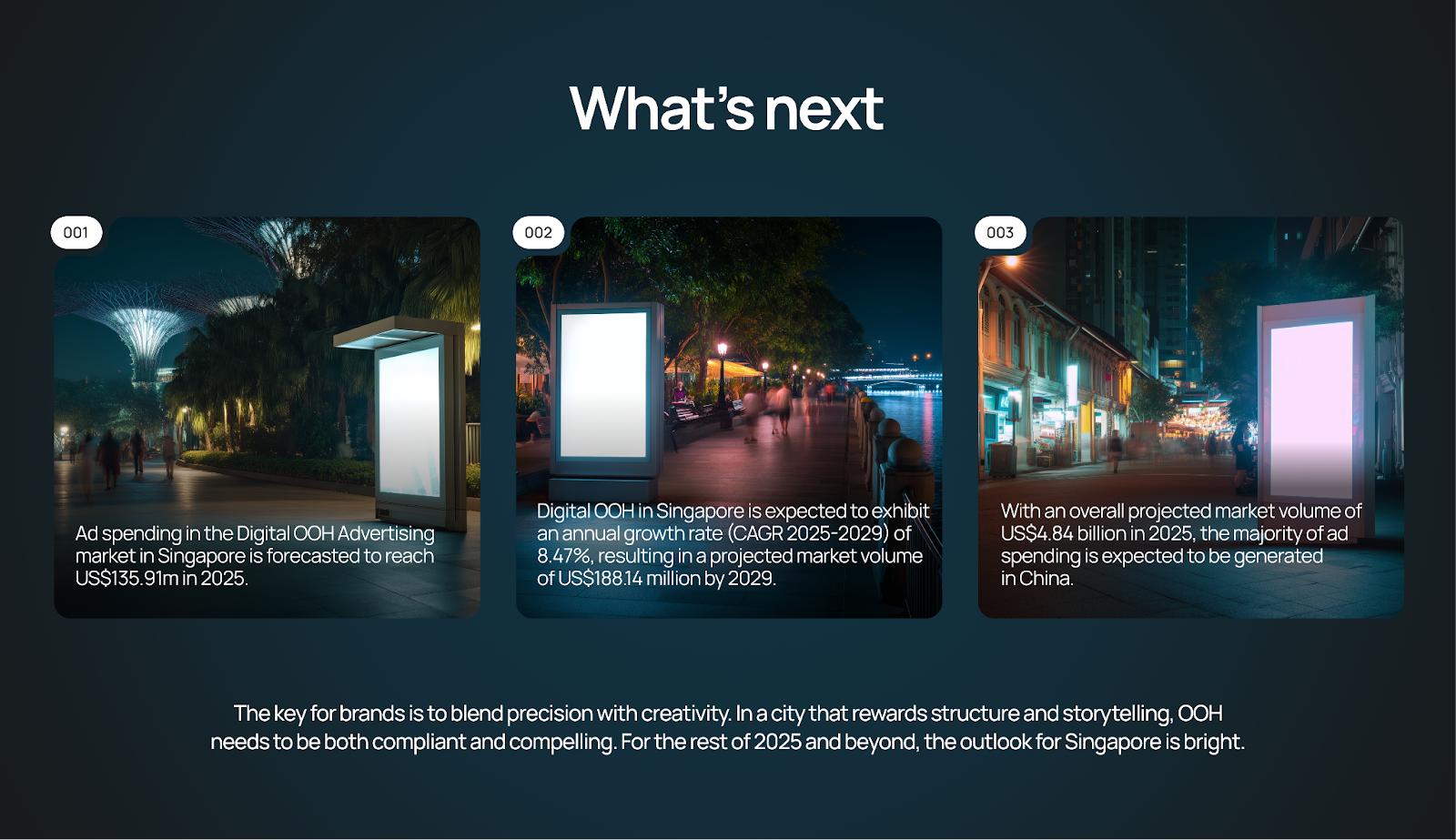
The key for brands is to blend precision with creativity. In a city that rewards structure and storytelling, OOH needs to be both compliant and compelling. For the rest of 2026 and beyond, the outlook for Singapore is bright:
- Ad spending in the Digital OOH Advertising market in Singapore was estimated to have reached US$135.91m in 2025.
- Digital OOH in Singapore is expected to exhibit an annual growth rate (CAGR 2025-2029) of 8.47%, resulting in a projected market volume of US$188.14 million by 2029.
- With an overall projected market volume of US$4.84 billion in 2025, the majority of ad spending is expected to be generated in China.
Ready to make a smarter impact in Singapore?
At billups, we don’t just buy space, we decode markets. With local intelligence, audience science, and global connectivity, we help brands succeed in one of Asia’s most sophisticated environments.
Let’s talk about how to turn strategy into standout.