Rethinking Airport OOH Measurement: Why Traditional Approaches Fall Short
.png)
Airports have always been seen as premium environments in out-of-home.
You’re reaching high-value audiences. People with time, intent, and, often, spending power. It’s why brands continue to invest heavily in airport media.
But for all that confidence, there’s been a persistent gap.
We’ve assumed airports work. We just haven’t been able to prove it properly.

A Complex, High-Value Audience
Airports don’t deliver a single audience. They deliver many, all moving through the same space in very different ways.
A business traveler heading to a meeting. A family on holiday. A transit passenger passing through. Airport staff moving with purpose. Each one has a different mindset, pace, and level of attention.
Even within a single journey, behavior changes.
Before security, people are focused and moving quickly. After security, they slow down. They browse. They spend time. They become more receptive.
Two people can walk past the same screen and experience it completely differently.
“If you treat that as one audience, you’re missing how people actually engage in these environments,” Kuzmin explains.
Time Isn’t Fixed. It’s Fluid.
One of the biggest assumptions in traditional OOH measurement is consistency.
Airports don’t behave that way.
Some passengers move through quickly. Others spend hours in terminals. Delays, layovers, and travel patterns all shape how long someone is exposed to media.
That variability makes it difficult to rely on standard impression models. Exposure isn’t just about passing a screen. It’s about how long someone is there, what they’re doing, and whether they’re even in a position to notice.
Movement Isn’t Linear
Airports aren’t designed for straight-line movement.
Passengers wander. They stop. They double back. They revisit spaces.
Someone might pass the same placement multiple times without realizing it. Another traveler might never come near it at all.
This creates a blind spot in traditional measurement. Frequency becomes harder to define. Exposure becomes harder to validate.
And yet, these movement patterns are exactly what shape how airport media performs.
Data Is Fragmented and Often Out of Reach
To understand what’s really happening, you need multiple data inputs.
Passenger volumes. Flight schedules. Dwell time. Movement patterns. Audience composition.
In reality, that data rarely sits in one place.
It’s fragmented across systems. It can be expensive to access. And in many cases, privacy constraints limit its use, especially indoors.
The result is a measurement environment where decisions are often based on partial visibility.
Attribution Doesn’t Stop at the Terminal
Airport journeys don’t begin and end in the same place.
A traveler might see an ad in London, board a flight, and take action days later in New York. Or not until they return home.
Traditional attribution models struggle with that gap.

This is one of the reasons airport media has historically been undervalued in performance discussions. Not because it doesn’t work, but because it hasn’t been measured in a way that reflects how people actually behave.
The Industry Gap
Unlike other OOH environments, airport measurement lacks standardization.
Each airport operates as its own ecosystem. Different data sources. Different methodologies. Different levels of access.
That makes it difficult to compare performance across locations or build consistent benchmarks.
So while investment continues, the underlying measurement often relies on broad assumptions rather than precise insight.
A Smarter Approach Is Emerging
To properly measure airports, the model needs to change.
It’s no longer enough to look at static passenger counts or generalized impressions. What matters is how people move, how long they stay, and where attention concentrates.
That requires connecting multiple signals into a single view.
“To measure airports properly, you need to connect movement, dwell time, flight data, and audience composition,” says Kuzmin. “It’s not one dataset. It’s how they work together that creates clarity.”
This is where measurement begins to shift from estimation to understanding.
From Complexity to Clarity
What’s changing now is how these environments are being understood.
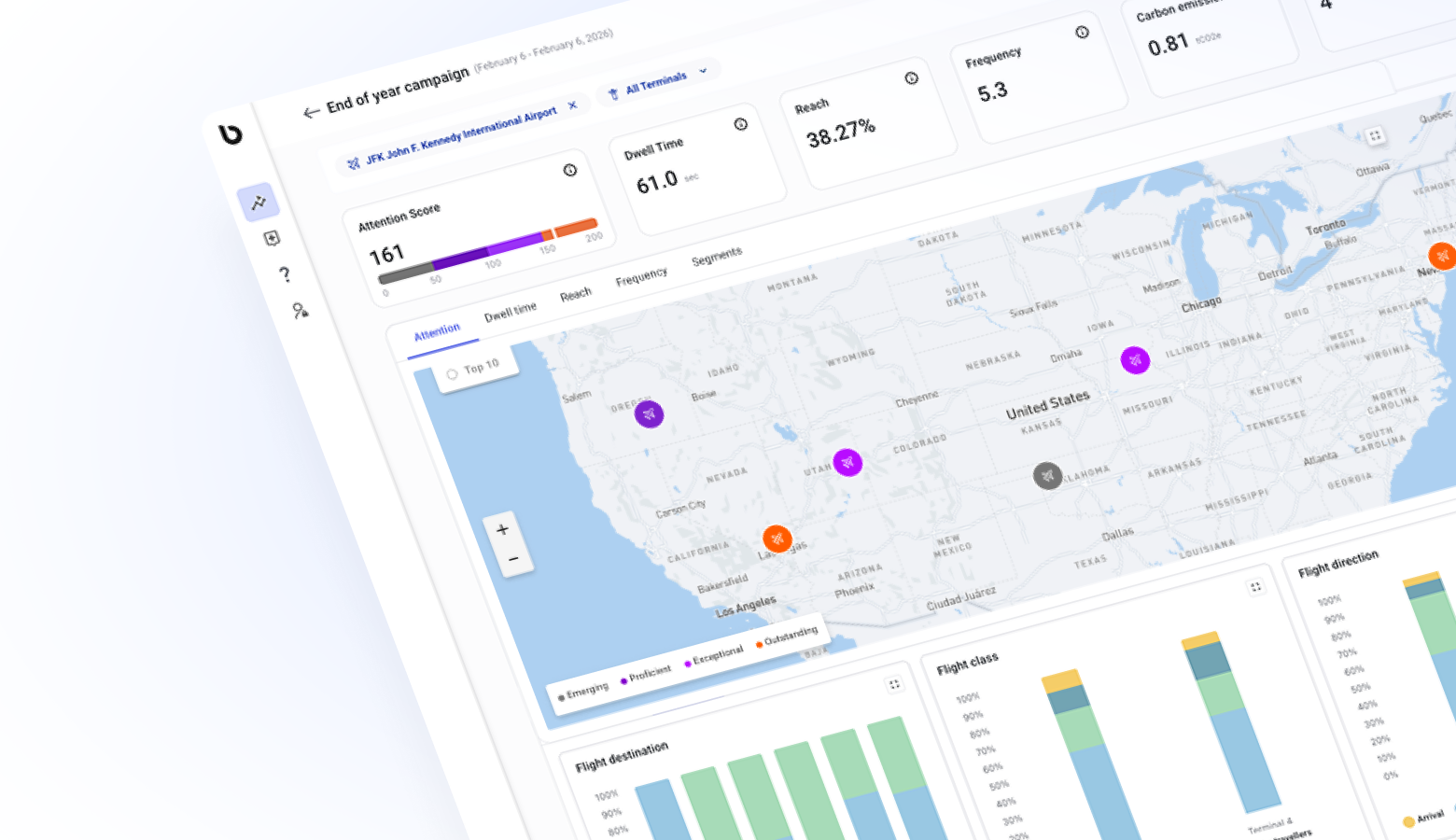
The next evolution of measurement goes beyond static impressions and fragmented data. It requires a more intelligent approach; one that connects audience, movement, dwell time, and real-world context into a single, actionable view.
"To measure these environments properly, you need to understand how different factors interact," says Kuzmin. "That is what creates a more accurate view of performance."
At billups, we’re building toward exactly that: a smarter way to understand airport audiences, grounded in real behavior, not assumptions. By integrating multiple data sources and applying advanced modeling, we’re able to move from broad estimates to precision-led airport measurement.
The result? Greater transparency, stronger accountability, and ultimately, more effective campaigns in one of the most valuable environments in OOH.
This is just the beginning of how airport media can, and should, be measured.
The Takeaway
Airports remain one of the most valuable environments in OOH.
What is changing is the ability to demonstrate that value with greater precision and confidence and the next phase of this evolution is already taking shape.
Looking to better understand how your airport campaigns perform across markets and over time?
Get in touch with the billups team to explore what’s possible.